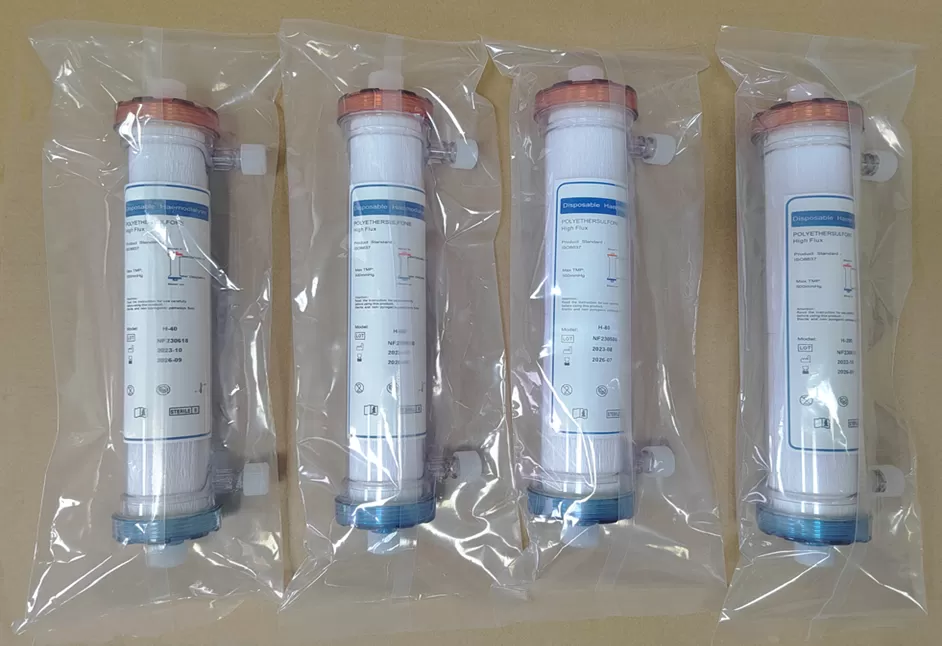
Hemodialysis Filter Dialyzer for Optimal Blood Purification

Intended Use
The Disposable Haemodialyser is intended for haemodialysis treatment as part of renal replacement therapy for patients with acute or chronic renal failure.
Contraindications
This product has no absolute contraindications for haemodialysis. However, use of this product is contraindicated in patients with known allergic reactions to polyethersulfone membranes.
Order Information
A-40, A60, A-80, A-200
1. Use this product according to instructions of a physician who is well familiar with the patient's condition.
2. Do not use for any other purposes than dialysis.
3. If any abnormalities such as foam generation or mixture, blood leakage, blood coagulation and hemolysis occur during the use of this product, take appropriate measures according to a physician's instructions.
4. In case drugs including an anticoagulant are administered before or during use of this product, follow a physician's instructions about the administration and dose and the administration time of the drugs.
5. Do not reuse this product, as it is intended FOR SINGLE-USE ONLY. Potential risks associated with reuse included:
- Life-threatening infections due to microbial contamination,
- Deterioration of solute removal performance and ultrafiltration performance,
- Exposure of patients and/or technicians to residual disinfectants and/or adverse reactions, and
- Damage to hollow fibers and/or potential leakage.
6. Keep the product away from chemical solvents, such as bleach and alcohols. Residual disinfectant in product may cause adverse patient reactions.
7. If the patient experiences abnormal symptoms during treatment with this product, such as discomfort, pruritus, urticaria, peripheral and facial edema, respiratory arrest, facial flush, erythema, asthmatic reaction, hypertension, hypotension and/or cardiac arrhythmia, initiate appropriate interventions as directed by the treating physician.
8. Adverse reactions (e.g., hypotension, hypertension, headache and nausea which are sometimes with hypovolemia or hypervolemia) may occur. Optimize fluid/electrolyte balance and dialysis parameters (blood flow rate and UF rate) to minimize who.
9. During dialysis, constantly monitor the patients who:
- have a history of hypotension with hemodialysis,
- have inflammatory reaction, allergic reaction, hypersensitivity, or increase in the immunity by infections,
- take hypotensive drugs such as inhibitor of angiotensin converting enzyme and calcium antagonist,
- use this product for the first time.
Precautions:
1. The Disposable Haemodialyser must be used under the supervision of qualified healthcare professionals. To prevent bacterial and pyrogenic contamination, it must be used in conjunction with a hemodialysis machine, dialysate, water, and concentrated solution that comply with applicable standards.
2. The maximum dialysate flow rate is 800 mL/min.
3. During treatment, the transmembrane pressure (TMP) must not exceed 66.5 kPa (500 mmHg).
4. The blood flow rate must be maintained between 150 mL/min and 500 mL/min.
5. Do not use if expired. Check the expiry date printed on the packaging before use.
6. Do not use if the outer packaging is damaged, torn, or shows signs of tampering, or if protective caps on the connectors are missing or loose.
7. This product is FOR SINGLE-USE ONLY; reuse is strictly prohibited. Reprocessing may cause patient harm, device failure, or cross-contamination. After use, dispose of it as infectious medical waste in accordance with local regulations to prevent infection risks.
8. The product is provided sterile and non-pyrogenic. Store in original packaging to maintain sterility until use.
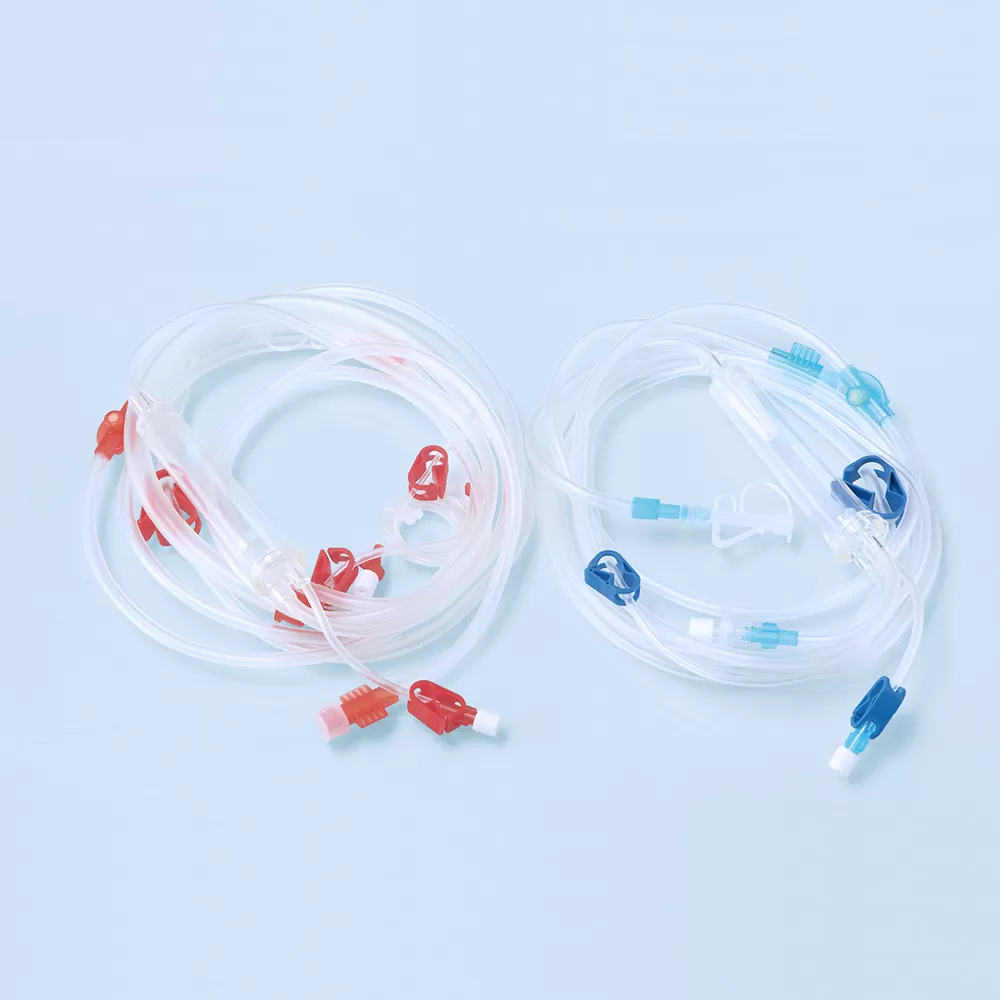
9. Color-coding for connectors:
- Arterial line (blood inlet): Red-coded connector
- Venous line (blood outlet): Blue-coded connector
10. Any incident (e.g., device malfunction, patient injury) related to the use of this dialyser must be reported immediately to both the manufacturer and the competent regulatory authority in the user’s country/region.
FAQs – Single-Use Haemodialyser
1. Q: What membrane material is used in this dialyser?
A: It features high-performance polyethersulfone (PES) membrane – excellent biocompatibility, high solute removal efficiency, and low protein adsorption. Widely preferred for acute and chronic dialysis.
2. Q: Is this dialyser safe for first-use patients?
A: Yes. However, first-use syndrome (hypersensitivity) is possible with any dialyser. Monitor patients closely, especially those with known allergies. PES membranes are generally well-tolerated.
3. Q: What are the absolute contraindications?
A: Do not use in patients with known allergic reactions to polyethersulfone (PES) membranes. No other absolute contraindications for haemodialysis.
4. Q: What models/sizes are available?
A: Available in A-40, A-60, A-80, and A-200. Different surface areas to match pediatric to large adult patients. Contact us for detailed specifications.
5. Q: What are the maximum operating parameters?
A:
Blood flow rate: 150–500 mL/min
Dialysate flow rate: ≤800 mL/min
TMP limit: ≤66.5 kPa (500 mmHg)
Exceeding limits may cause fiber rupture or performance drop.
6. Q: Can I reuse this dialyser?
A: Absolutely not. Strictly single-use only. Reuse risks:
Life-threatening infections
Reduced solute/ultrafiltration performance
Residual disinfectant exposure
Fiber damage/leakage
Reprocessing is prohibited.
7. Q: How do I identify arterial and venous connections?
A: Color-coded connectors:
Red = Arterial line (blood inlet)
Blue = Venous line (blood outlet)
Designed to prevent misconnection errors.
8. Q: What should I do if blood leakage occurs?
A: Immediately stop treatment, clamp lines, and assess. Blood leakage indicates possible fiber rupture. Replace the dialyser immediately. Do not continue use.
9. Q: Is this dialyser compatible with all dialysis machines?
A: Yes. Standard blood port and dialysate port configurations ensure compatibility with Fresenius, Braun, Gambro, Baxter, Nikkiso, Nipro, Kawasumi, Toray, Bellco, JMS, and others.
10. Q: What adverse reactions should I watch for?
A: Possible reactions: hypotension, hypertension, headache, nausea, pruritus, urticaria, facial edema, dyspnea, erythema, arrhythmia. If observed, stop treatment immediately and follow physician instructions.
11. Q: Does this product contain DEHP or latex?
A: The dialyser housing and potting material are DEHP-free. Membrane is polyethersulfone, housing is polycarbonate/polypropylene. Latex-free. Suitable for sensitive populations.
12. Q: What certifications does this dialyser have?
A: Manufactured under ISO 13485, CE marked (Class IIb), compliant with EU MDR. Sterile, non-pyrogenic, EO sterilized.
13. Q: How should I store and handle this product?
A:
Store in original packaging, cool/dry place
Do not use if expired (check expiry date)
Do not use if package damaged or caps missing
Keep away from chemical solvents (bleach, alcohol) – may damage housing
14. Q: What is the shelf life?
A: 3 years from sterilization date. Sterilized by ethylene oxide (EO). Double-peel sterile packaging.
15. Q: What should I do if a serious incident occurs?
A: Report immediately to the manufacturer and your local competent authority.