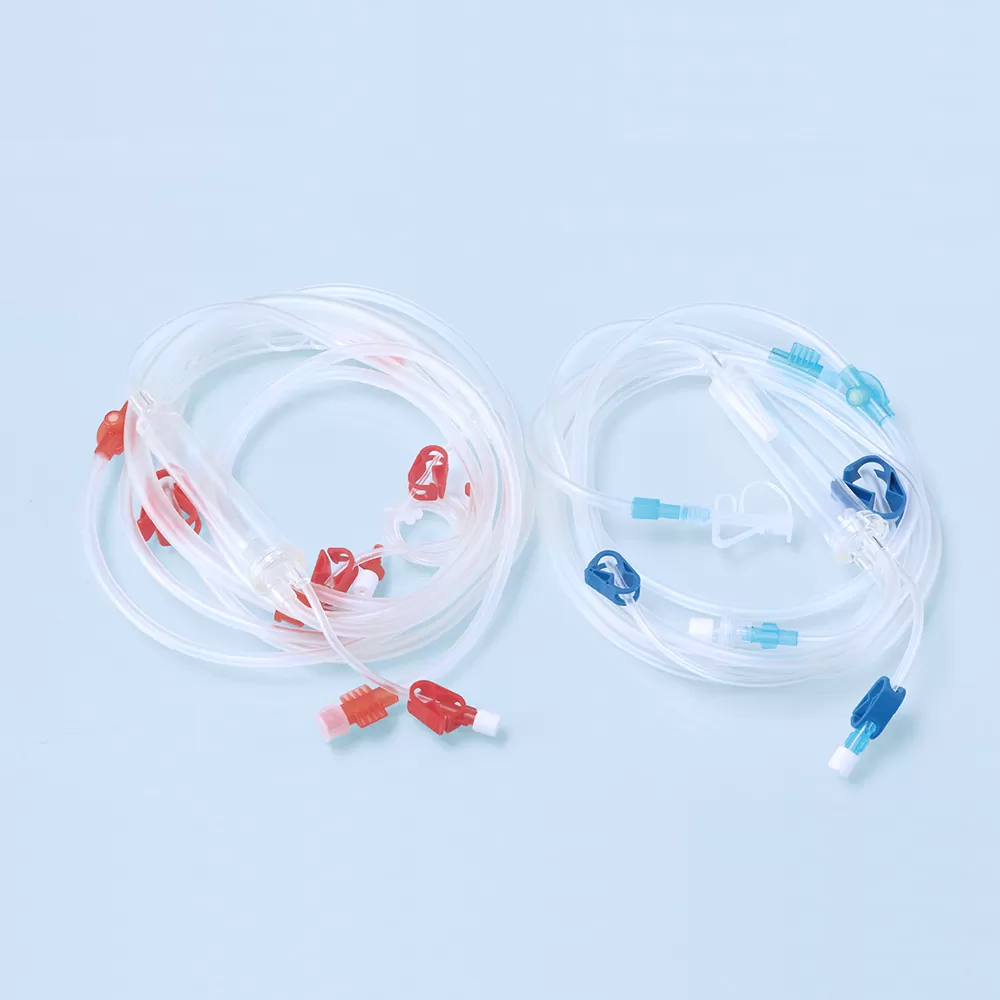
Sterile Hemodialysis Blood Tubing Set


Intended Use and Indication
Indended Use:
The Disposable Blood Line is intended to establish blood circulating path outside human body. It is sterile, single use and intended to be used by trained and experienced professionals.
Indications:
The Disposable Blood Line is used to connect with other hemodialysis devices to establish blood circulating path outside human body to form a hemodialysis system for the acute and chronic hemodialysis therapy.
Ordering information

Contraindications
No absolute contraindications.
Warning
1. Prior to use, read the instruction carefully.
2. The product can be used in conjunction with most of the currently available haemodialysis equipment, including those from brands such as Fresenius, Braun, Gambro, Baxter, Nikkiso, Nipro, Kawasumi, Toray, Bellco, JMS.
3. Single use only. Any resterilization or reuse of the products can result in hazard to the patients.
4. The treatment should be conducted in strict asepsis circumstance.
5. The product is sterilized by Ehtylene Oxide and free from pyrogens.
6. Do not use the product if the protective end caps are not in place or the primary package is damaged.
7. Ensure that the products connect with other medical devices is correct, safe and reliable. If blood leaks, nursing staff should remove obstacle and make adjustment. If it fails, replace the entire blood line.
8. To avoid air embolism caused by the entry of air into the patient's veins, we recommend using air detector.
9. The product is made of medical-grade PVC, which contains DEHP in a concentration that is above 0.1% weight by weight.
10. Attention should be paid when this product is used for pregnant women, breastfeeding mothers, infants and children. Try to use alternatives.
11.Generic names of materials that directly or indirectly contact the fluid path are available to the user upon request.
12.We require that medical devices in combination with Disposable Blood line should be those that have been marked in according with local regulations.
13.Use a 20 gauge or smaller conventional metal needle for accessing the injection ports.
14.Use of incompatible connectors with this blood line may result in blood loss, patient injury or death.
15.Disinfect the blood line using 70% alcohol or 10% Povidone-lodine solution. Other disinfectants intended to be used with this set must be determined as compatible prior to clinical use.
16.Ensure there are no kinks in the bloodline tubing during set-up and patient use.
17.This product can withstand a maximum positive pressure of 100kpa and a maximum negative pressure of 80kpa. During hemodialysis, the maximum blood flow rate is not exceed 300m/min.
18.During hemodialysis treatment, the pressure monitoring tube should be equipped with a transducer protector. The Transducer Protector can prevent the monitor being contaminated by blood. If the transducer protector gets wet with liquid or blood, please replace the transducer protector.
20.Do not expose disposable blood line connections to a lubricant. Exposure could cause connections to separate resulting in patient injury or death.
21.Please disposal the device safely in accordance with local regulations to avoid infection or microbial hazards.
22.If any serious incident that has occurred in relation to the device you should reported to the manufacturer of the device and the competent authority of the Member State in which you are established.
FAQs – ABLE® Disposable Blood Line
1. Q: Which dialysis machines is this blood line compatible with?
A: It is compatible with most major brands, including Fresenius, Braun, Gambro, Baxter, Nikkiso, Nipro, Kawasumi, Toray, Bellco, and JMS. Tested and validated – no compatibility concerns.
2. Q: Does this product contain DEHP? Is it safe?
A: Yes, it contains DEHP >0.1% w/w (medical-grade PVC). It is safe for general adult use, but for pregnant women, breastfeeding mothers, infants, and children, alternatives are recommended. Material composition information is available upon request.
3. Q: What are the maximum pressure and flow rate limits?
A: Max positive pressure: 100 kPa; max negative pressure: 80 kPa.
Max blood flow rate: ≤300 mL/min. Exceeding these limits may compromise tubing integrity.
4. Q: Can I reuse or resterilize this blood line?
A: Absolutely not. Strictly single-use only. Reuse may cause infection, material degradation, air embolism, or death. Sterilized by EO – do not re-sterilize.
5. Q: What should I do if blood leaks during treatment?
A: Immediately check connections and tubing for kinks or dislodgement. If leakage persists, replace the entire blood line. Do not attempt temporary fixes – patient safety first.
6. Q: How do I prevent air embolism during dialysis?
A: We strongly recommend using an air detector in conjunction with this blood line. Also ensure all connections are secure and tubing is bubble-free before starting treatment.
7. Q: How should I disinfect the blood line?
A: Use 70% alcohol or 10% povidone-iodine solution. Other disinfectants must be validated for compatibility prior to use – incompatible chemicals may damage tubing or cause leakage.
8. Q: Can I use any syringe or needle to access the injection port?
A: Use only 20 gauge or smaller conventional metal needles. Needles larger than 20G or non-standard connectors may damage the port and cause blood loss or patient injury.
9. Q: What certifications does this product have?
A: Manufactured under ISO 13485, CE marked, and compliant with EU MDR. Sterile, pyrogen-free, EO sterilized. Full documentation available for tenders and regulatory submissions.
10. Q: Is the product latex-free?
A: The tubing is PVC-based, DEHP-plasticized. If you require DEHP-free or non-PVC alternatives, please contact us – we offer customized solutions.
11. Q: What should I do if a serious incident occurs?
A: Report immediately to the manufacturer and your local competent authority.